

Tutoring software reviews: 172 complaints sorted
We read 172 public complaints about tutoring software and sorted them into 17 themes: what owners struggle with most, how we counted, and the full dataset.
Some of our centres
 Centre de Francisation et de Tutorat au Québec
 Coeur de Tuteur
 Lingua Franca Institute
 Mentors Éducation
 OnCourse Education
 Top Tutorat
 Tuteur Match
 Tutorat au Top

A star rating tells you how people feel about a piece of software. It doesn’t tell you what will go wrong in your month, and the only place that answer lives is in the complaints, usually in the one line a happy reviewer writes under “cons.”
So we went and read them. We collected public complaints about the software people use to run tutoring businesses, and on October 14, 2026 we finished reading and coding all 172 of them. This post is what we found, how we counted, and the full dataset, so you can see exactly what we counted.
The short version: the biggest complaints are about money. Getting paid came up in 35 complaints and building invoices by hand in 34. Then come what parents see (28), how long setup takes (26), and a bill that keeps growing (24).
Where the 172 complaints came from
We looked anywhere an owner, a tutor or an office manager might write down what annoys them about their software, as long as anyone could read it:
- 122 came from review sites, mostly Capterra, plus Software Advice, G2 and Trustpilot.
- 41 came from public forums, mostly tutoring communities on Reddit.
- 9 came from a public feature-request board, where a vendor’s own customers ask for what’s missing.
They span 2016 to 2026, and 131 of them were written in 2022 or later, so this is mostly a picture of the last few years, not a history lesson. We checked 133 of them on their own page. The other 39 we read in the text a listing page or a search result showed, because the review’s own page would not load for us.
We are not naming the products. The point of this study is what owners struggle with, and a list of who got the most complaints would mostly measure who has the most customers. Instead, we grouped them by kind of software. 90 complaints were about tutoring-business software, 51 about software built for class-based studios (dance, gymnastics, swim), 28 named no software at all because the writer was running on spreadsheets and chat groups, and three were about a music-lesson app, a general booking tool and an accounting package.
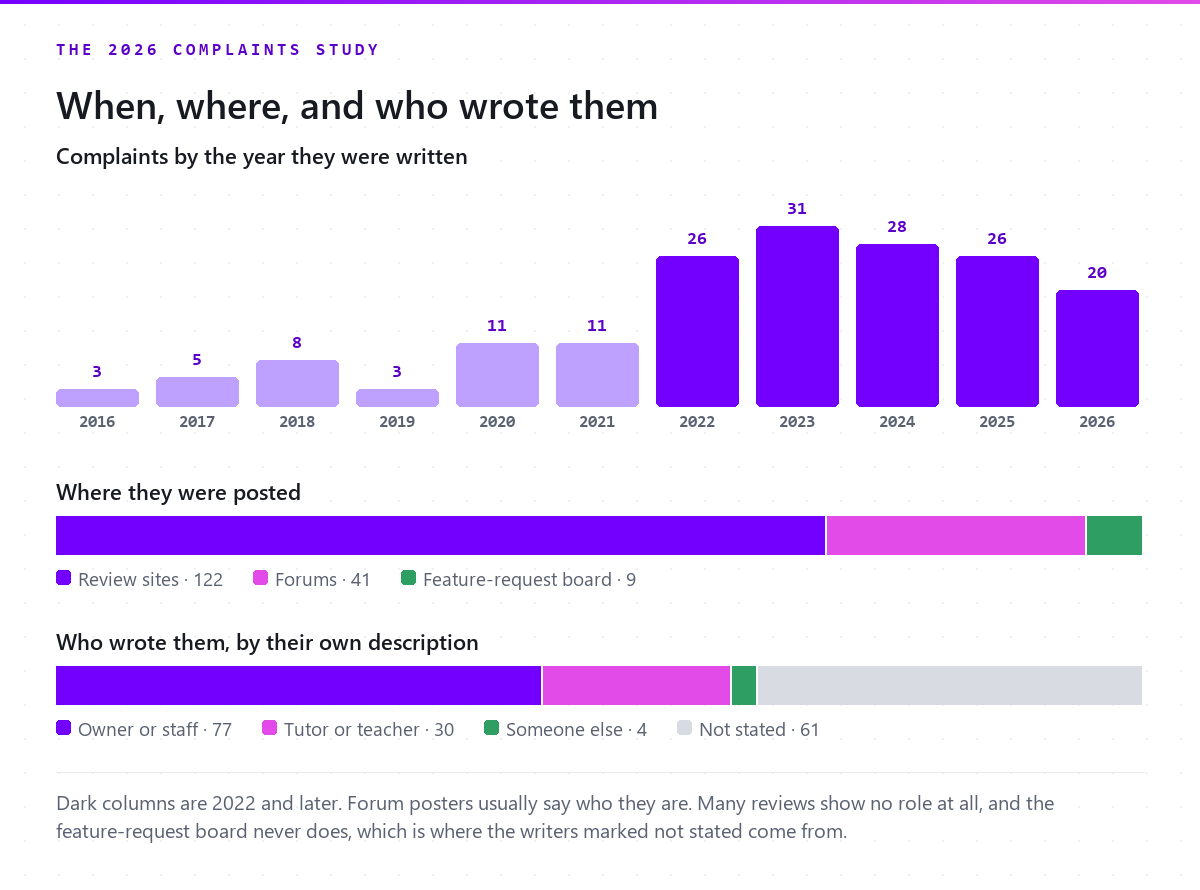
As for who wrote them, 77 were owners, directors or office staff, 30 were tutors or teachers, 4 were someone else (a spouse, a parent doing a tutor’s books), and 61 didn’t say.
Why a 4.8 rating and 172 complaints can both be true
Here’s the part that surprised me. Of the 122 complaints that came with a star rating, 81 were attached to a rating of four stars or more. Only 11 came with one or two stars.
That isn’t a quirk of tutoring software. When Verena Schönmüller, Oded Netzer and Florian Stahl studied over 78 million reviews from 16 major platforms, they found the same lopsided shape on many of them: lots of happy ratings, a few furious ones and not much in between. They trace it mainly to who chooses to write a review in the first place.
What that means for you is simple. If you only look at the average, every product in this category looks nearly perfect. If you read the “cons” lines, you find out how each one fails, and whether it fails in a way your centre can live with.
The 17 themes, ranked
We coded each complaint by what it was actually about, and a complaint could touch more than one theme. 95 of the 172 did, like an invoice problem that was really a payment problem. That’s why the bars below add up to more than 172.
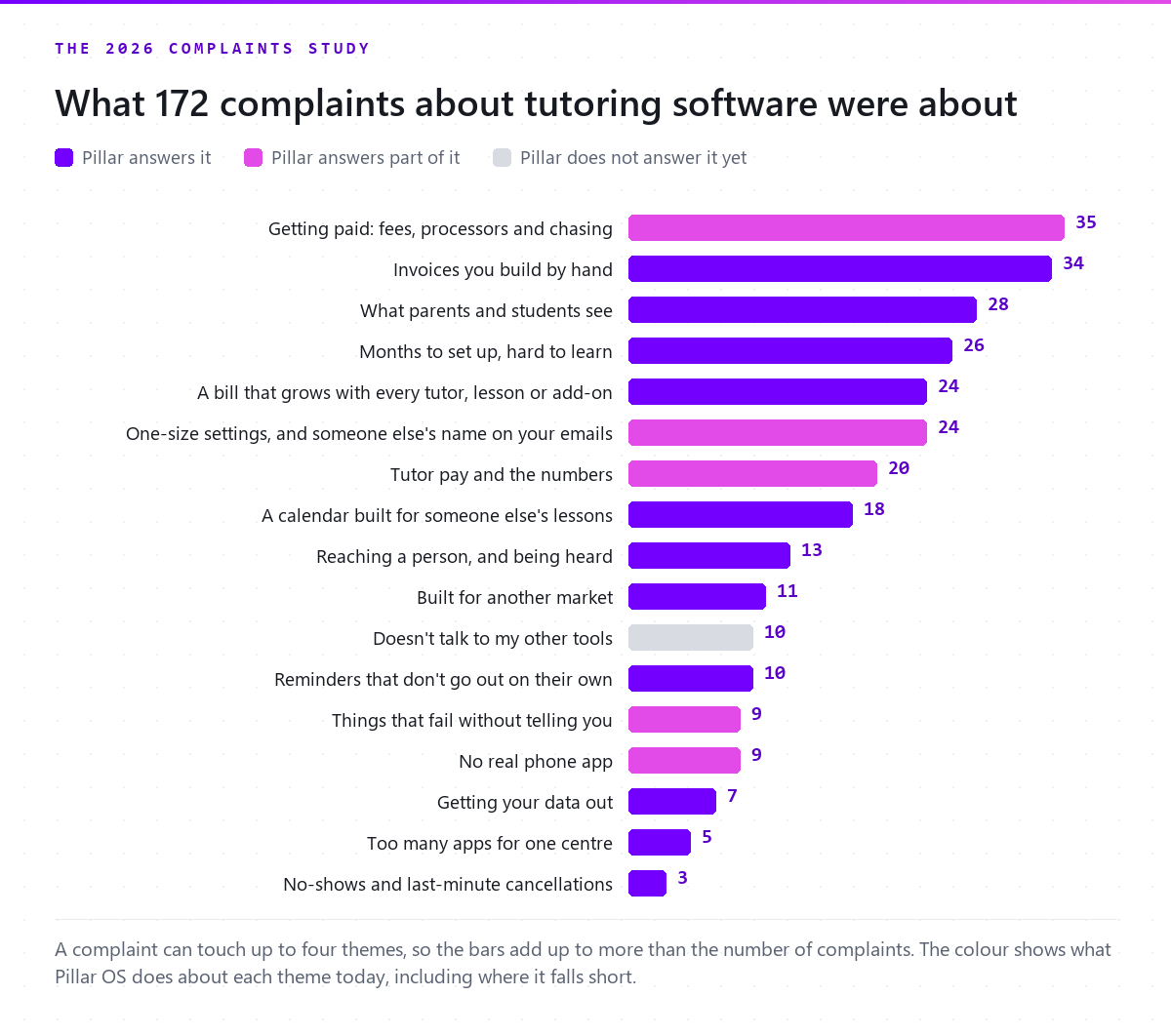
1. Getting paid (35 complaints)
Card fees that add up, a payment processor the owner can’t leave, and hours spent chasing families who meant to pay. One owner asked their software for the plainest thing in the world, the option to take bank transfers. I wrote a whole post on what card payments really cost a centre and how autopay ends the chasing, and the pain page on chasing payments shows how Pillar handles it.
2. Invoices you build by hand (34)
Invoices that don’t follow the lessons, credits that have to be worked out on paper, a monthly run that eats an evening. When the same reviews praise invoicing, it’s for invoices that build themselves from the lessons. More on that in invoices built by hand and the tutoring invoice template.
3. What parents and students see (28)
Portals that confuse families, logins that don’t work, and parents who still email to ask when the next lesson is. See the questions parents keep asking.
4. Months to set up, hard to learn (26)
One owner described three months and more than $2,000 of outside help before they could use their new system. Setup is where software loses people before it ever helps them. What a reasonable setup looks like.
5. A bill that keeps growing (24)
Fees per tutor, per lesson or per add-on, and a price that climbs as the business grows. It’s never one big number, it’s many small ones nobody decided on. How software pricing creeps.
6 to 17. The rest
The long tail is worth reading too, because each theme is somebody’s whole problem:
- One-size settings and someone else’s name on your emails (24): your name on family emails
- Tutor pay and the numbers (20): tutor payroll in a spreadsheet
- A calendar built for someone else’s lessons (18): one-to-one lesson scheduling
- Reaching a person and being heard (13): tutoring software support
- Built for another market (11): built for Québec centres
- Doesn’t talk to my other tools (10)
- Reminders that don’t go out on their own (10): automatic lesson reminders
- Things that fail without telling you (9)
- No real phone app (9): a tutoring app on your phone
- Getting your data out (7): export your tutoring data
- Too many apps for one centre (5): too many tutoring apps
- No-shows and last-minute cancellations (3)
That last one is interesting. No-shows cost a centre real money (our no-show cost calculator will show you yours), and yet only 3 complaints blamed the software for them. In my opinion that’s because owners see no-shows as a family problem rather than a software problem, even when better reminders and a clear cancellation rule would catch most of them.
Who’s on the other end of these complaints
It helps to remember how small most of these businesses are. Canada’s industry classification files private tutors under “all other schools and instruction,” and the federal industry profile for that class lists “Tutors, private” among its examples. In 2024, the 10,185 small and medium businesses in it earning between $30,000 and $5 million brought in $271,700 in revenue on average and kept $55,700 as net profit, and 84.2% of them were profitable.
The wider group it belongs to, which the government describes as including tutoring and exam preparation, counted 32,176 establishments in 2025, and 99% of them have fewer than 100 employees.
When the average business keeps about $55,700 a year, a card fee nobody chose, an evening lost to invoices or a bill that grows with every tutor isn’t a small annoyance. It comes straight out of what the owner takes home, and I think that’s exactly why money tops this list.
What Pillar answers, and what it doesn’t
We built this research to decide what to build, so it would be dishonest to stop at the themes we’re good at. Of the 17 themes, Pillar OS answers 11, answers 5 only in part, and doesn’t answer 1 at all. Counted complaint by complaint, we can show Pillar answering 128 of the 172. The other 44 it doesn’t answer, or we couldn’t confirm that it does.
Here is what Pillar doesn’t do today, from the complaints it can’t answer:
- No sync with accounting software, no profit-and-loss report, and no build-your-own reports
- No two-way Google Calendar sync (calendars subscribe one way) and no undo for a schedule change
- No automatic bank debit for families and no automatic matching of Interac e-transfers, which are recorded by hand
- No way to split one child’s fee between two separated parents
- No public API, and a move from another system brings students, families and tutors, not past lessons or invoices
- Texting is a paid add-on, and Pillar is priced by active students too
If any of those is the thing your centre can’t live without, you should know before you book a demo, not after.
The dataset
Every number in this post comes from our coded file, and both charts are drawn straight from it by a script. You can download it: the 172 complaints as a spreadsheet, one row per complaint, with its date, kind of software, themes, who wrote it, where it was posted, the rating if there was one, a paraphrase and the site it was posted on. Product names are replaced by “[software]” and reviewer names are left out. Links are left out too, because a review page’s web address carries the product’s name.
A few limits, so you read it fairly. Every complaint in the set is in English. Facebook groups aren’t publicly indexed, so they’re missing. Some complaints are years old and may have been fixed since. And a complaint is one person’s experience, not a measurement of a product.
The whole study, theme by theme with what Pillar does about each one, lives on what tutoring centre owners complain about. The research is due for a refresh in January 2027.
If you run a centre, I’d love to hear which of these you live with every week. The pattern is clear enough in the data, but the fix always starts with the owner who has the problem, and we need to hear from you to get it right.

Steven Kallini · Founder
Mechanical engineer by trade, hooked on computers since he was a kid, and a principal process engineer for 13 years before Pillar OS. That job was finding where a process quietly leaked time and money, then designing the fix. Pillar OS is the same work, aimed at the admin that eats a tutoring owner’s week.
