

Tutoring payments: credit card fees, e-transfer, autopay
What a card payment really costs a tutoring centre, why Quebec bans card surcharges, when e-transfer beats cards, and how autopay ends the chasing.
Some of our centres
 Centre de Francisation et de Tutorat au Québec
 Coeur de Tuteur
 Lingua Franca Institute
 Mentors Éducation
 OnCourse Education
 Top Tutorat
 Tuteur Match
 Tutorat au Top

Getting paid for tutoring should be the easy part, whether it comes by credit card or e-transfer. You did the work and the family agreed to the price, and then the month ends and you’re writing a third polite reminder to a parent who meant to pay last week and simply forgot, again.
When we read 172 public complaints about tutoring software, getting paid came up more than anything else, in 35 of them: card fees, the payment processors centres are stuck with, and the hours spent chasing. One tutor described parents who pay every second class and still need a reminder almost every time (the thread). Another owner asked her software for one simple thing, the option to take bank transfers instead of cards (the review).
I spent thirteen years as a process engineer, and in my experience a money problem is almost always a flow problem. So here is how the money actually flows for a tutoring centre in Canada, and where each way of paying leaks.
What a credit card payment costs a tutoring business
Stripe’s standard Canadian pricing is 2.9% plus 30 cents for each successful payment with a domestic card, with a little more for cards typed in by hand or issued abroad. Other processors publish their own rates, so check yours on its own pricing page.
On a $250 monthly invoice that is $7.55, and $242.45 lands in your account.
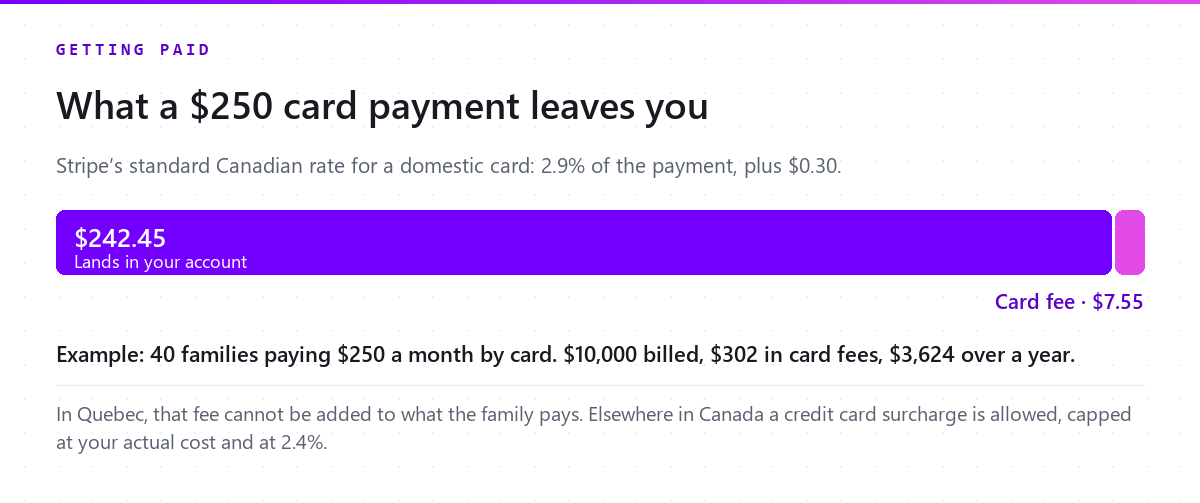
Seven dollars doesn’t sound like much until you multiply it. Forty families paying $250 a month by card is $10,000 billed and $302 in fees, which comes to $3,624 over a year, and it leaves without anyone ever deciding that it should.
In Quebec, you can’t pass the fee on
This is where a lot of owners get surprised. In most of Canada a merchant may add a surcharge to a credit card payment, as long as it stays under their actual cost and never goes above 2.4%, and the card network and the customer are told before the payment goes through. The Financial Consumer Agency of Canada sets out the conditions, and it names the one province where the option doesn’t exist.
In Quebec, the Office de la protection du consommateur is plain about it. A merchant can’t charge a fee to a consumer who pays by debit or credit card, and a sign beside the cash register doesn’t change that. The cost of taking cards is an operating cost.
So if you run a centre in Quebec, the fee is yours. Build it into your rates, or give families a cheaper way to pay that they actually like using.
Interac e-Transfer is cheaper, but you do the matching
Most Canadian families already know how to send an Interac e-Transfer. What it costs your business is set by your bank and your account, and in the business fee schedules I’ve seen it’s a flat amount per transfer or part of a monthly plan, not a percentage of what the family pays. Check your own schedule rather than a number from a blog, including this one.
Interac now offers Business Request Money, which lets a business send a payment request instead of waiting for one, through participating banks. With Autodeposit turned on, the money arrives without a security question.
The catch is the part nobody budgets for. An e-transfer arrives with a name and a short message, and someone has to work out which family it came from, which invoice it pays and whether it covers the full amount. Do that for forty families and you’ve built yourself a second job. If you take e-transfers, put a short invoice number on every invoice, ask families to type it in the message, and record each payment against its invoice the day it arrives.
Autopay is what actually stops the chasing
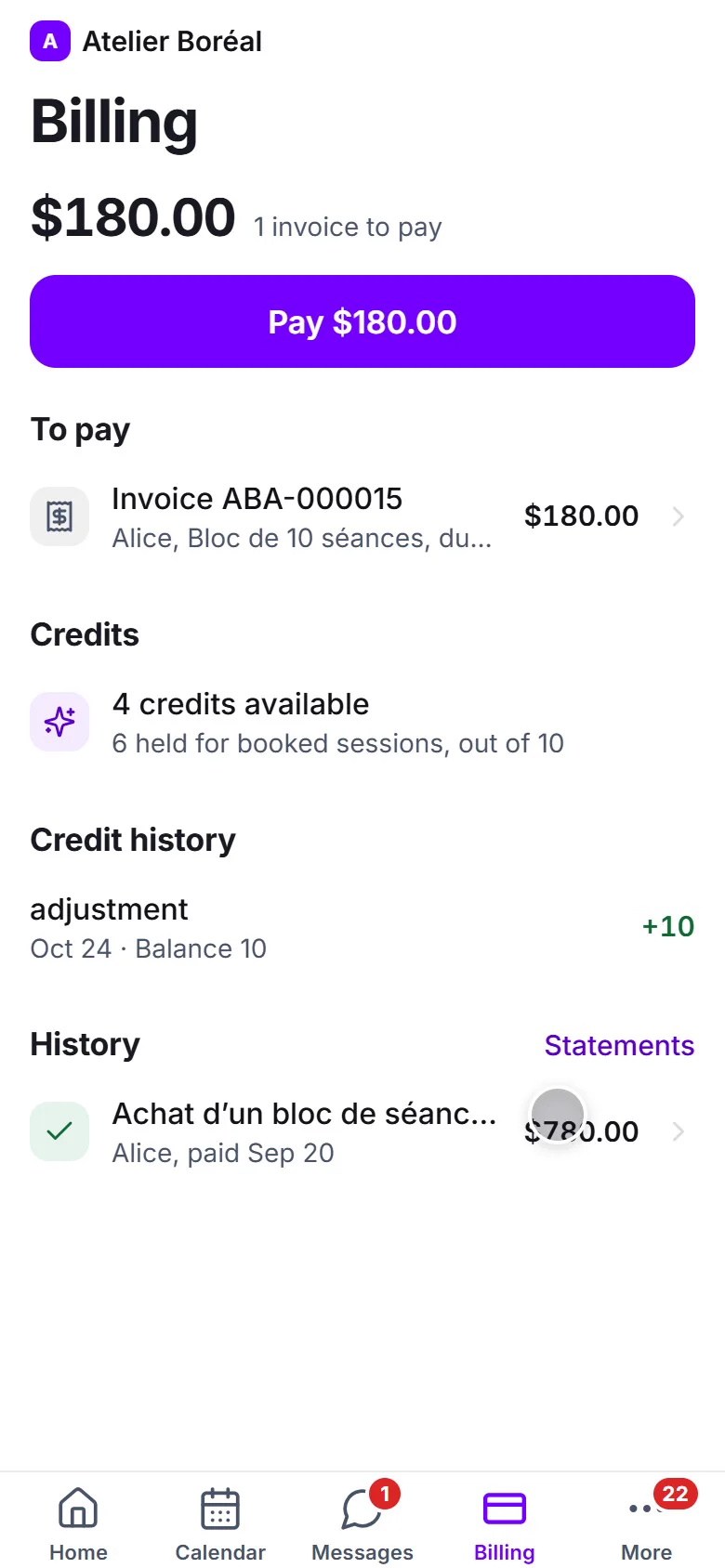
Reminders help, and the good ones stop on their own the moment a payment is recorded, so nobody gets nagged about an invoice they already paid. But in my opinion the thing that really ends the chasing isn’t a better reminder. It’s a card on file with automatic payment for the families who want it, because the payment happens on the day it’s due and the reminder never has to go out at all.
Not every family wants that, and nobody should be pushed into it. The goal is a default that works for most families and a clean way to pay for everyone else.
A setup that works for most centres
| Families who… | Offer them | What you watch |
|---|---|---|
| Pay the same amount every month | A card on file with autopay | Failed payments and expired cards |
| Prefer to pay from their bank | Interac e-Transfer, with the invoice number in the message | Matching each transfer to its invoice |
| Pay at the front desk | Cash or cheque, recorded the same day | A receipt, and a line in the same ledger |
Whatever mix you choose, two rules hold. Print your own payment instructions on every invoice, so nobody has to ask how to pay. And record every payment the same way, whatever it came by, so the balance a parent sees is the balance you see.
If you want to know what late payments are costing you right now, the late payment calculator does the arithmetic with your own numbers.
What I’d set up this week
- Look up what your processor charges, on its own pricing page, and multiply it by a normal month.
- If your centre is in Quebec, take any card surcharge off your invoices today.
- Turn on Autodeposit and put an invoice number on every invoice.
- Offer autopay to the families who already pay the same amount every month.
- Set reminders that stop the moment a payment is recorded.
Getting paid is a system, not a personality trait, and the families who pay late are rarely the problem. Most of them are waiting for the system to make paying easy.
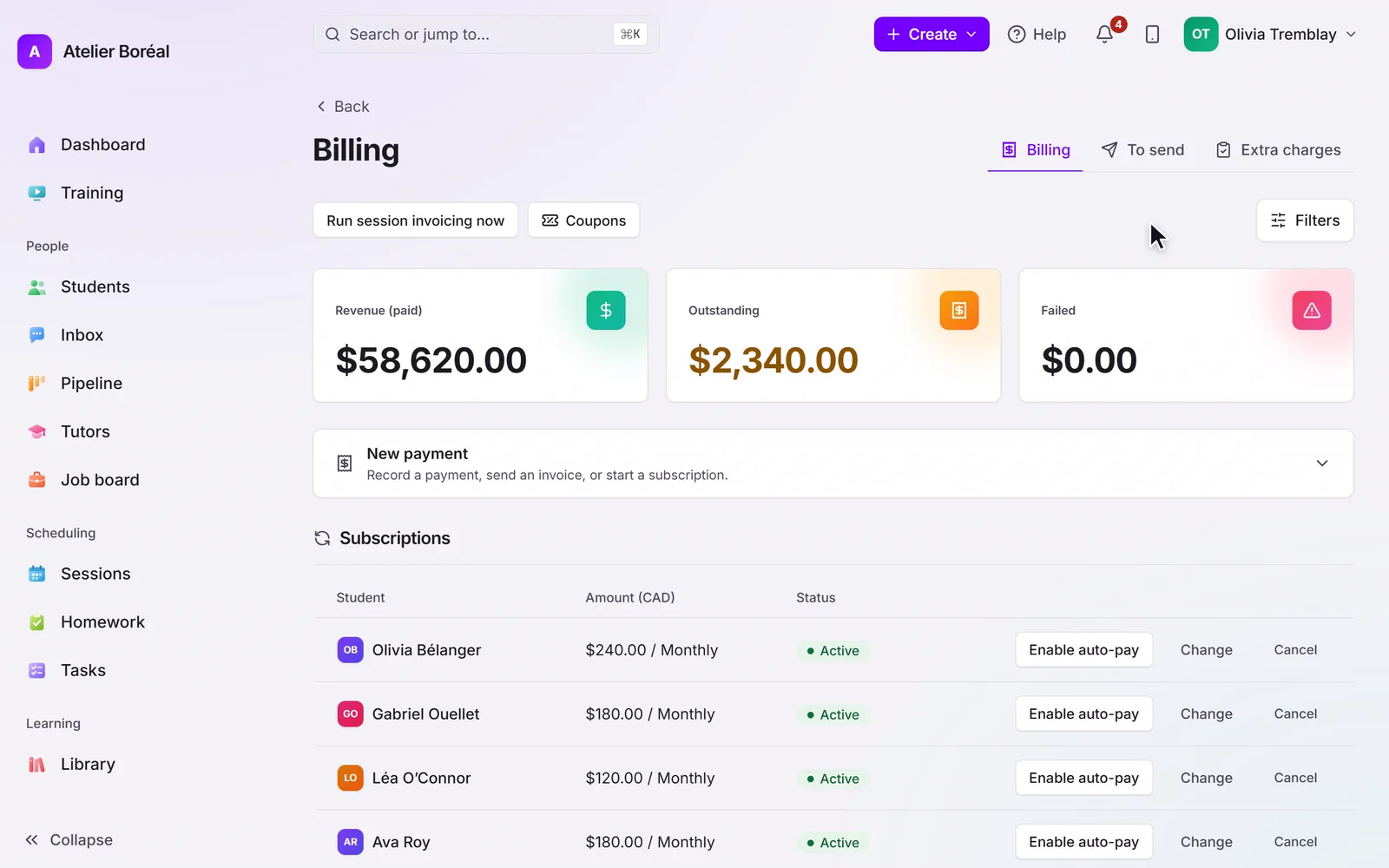
In Pillar OS, families pay the way you choose: your own Stripe or Global Payments account, or e-transfer, cash and cheque, with your own payment instructions printed on every invoice and reminder, and Pillar adds no fee of its own on top of your payment company’s. That’s in tutoring billing and payments, and the page on chasing tutoring payments shows what owners told us and how it’s handled. For what an invoice has to show in the first place, start with the tutoring invoice template and the guide to tutor invoicing and billing.

Steven Kallini · Founder
Mechanical engineer by trade, hooked on computers since he was a kid, and a principal process engineer for 13 years before Pillar OS. That job was finding where a process quietly leaked time and money, then designing the fix. Pillar OS is the same work, aimed at the admin that eats a tutoring owner’s week.
