

How much to charge for tutoring, from 5 costs
Work out a tutoring rate from what an hour really costs: tutor pay, payroll costs, unbilled hours, fixed costs and card fees, then the margin you keep.
Some of our centres
 Centre de Francisation et de Tutorat au Québec
 Coeur de Tuteur
 Lingua Franca Institute
 Mentors Éducation
 OnCourse Education
 Top Tutorat
 Tuteur Match
 Tutorat au Top

How much to charge for tutoring is the question every centre owner asks, and most answers start in the wrong place. They tell you what other tutors charge. That tells you what the market will bear, and nothing about whether your centre makes money at that price, because nobody else pays your rent, your tutors or your card fees.
A price is a sum before it is a number. One hour of tutoring at your centre carries five costs, and the price has to cover all five and then leave you a margin. If you add them up honestly, the number usually comes out higher than owners expect, and in my opinion that surprise is the most useful thing a pricing exercise gives you.
I spent thirteen years as a process engineer, and the habit that stuck is simple. You don’t guess what a process costs, you walk it from start to finish and write down every place money leaves. Here is that walk for one billed hour, with Canadian figures from official sources wherever one exists.
1. What you pay the tutor
Start with the hourly rate you pay, before anything else gets added. If you want an outside reference, Job Bank publishes wages from Statistics Canada’s Labour Force Survey. For tutors in secondary school subjects, the Quebec figures are $16.60 an hour at the low end, $20.00 at the median and $28.50 at the high end, for 2023 and 2024.
That is what tutors earn, not what families pay. And the floor for an employee is set by law, since Quebec’s general minimum wage rose to $16.60 an hour on May 1, 2026.
2. What employing them costs on top
If your tutors are employees, every dollar of pay carries a share you pay as the employer, and in Quebec it adds up fast.
- Quebec Pension Plan. The employer pays 5.3% to the base plan and 1% to the additional plan on earnings above $3,500 a year, up to $74,600.
- Employment Insurance. The 2026 employee rate in Quebec is 1.30%, and the employer’s premium is 1.4 times that, which makes it 1.82%.
- Quebec Parental Insurance Plan. The employer rate for 2026 is 0.602%.
- Vacation pay. The CNESST sets the vacation indemnity at 4% of gross pay, rising to 6% once a tutor reaches three years of continuous service.
Those four come to about 12.7% of pay. The Health Services Fund contribution and your CNESST premium come on top, and both depend on your total payroll and your sector, so ask whoever runs your payroll for your own rates. Outside Quebec the pieces change but the logic doesn’t. The Canada Pension Plan rate for 2026 is 5.95% for the employer, and the employer’s EI premium is 1.4 times the 1.63% employee rate.
If your tutors are contractors, this line is close to zero. But the label isn’t yours to pick. The CRA is clear that “the facts of the working relationship as a whole decide the employment status”, whatever the contract says, so price for the relationship you actually have.
3. The hours you pay for and never bill
This is the cost owners forget most often. A no-show you still pay the tutor for, the half hour of paid prep, the training afternoon, the session that ran over and wasn’t charged. None of those appear on an invoice, and all of them get paid.
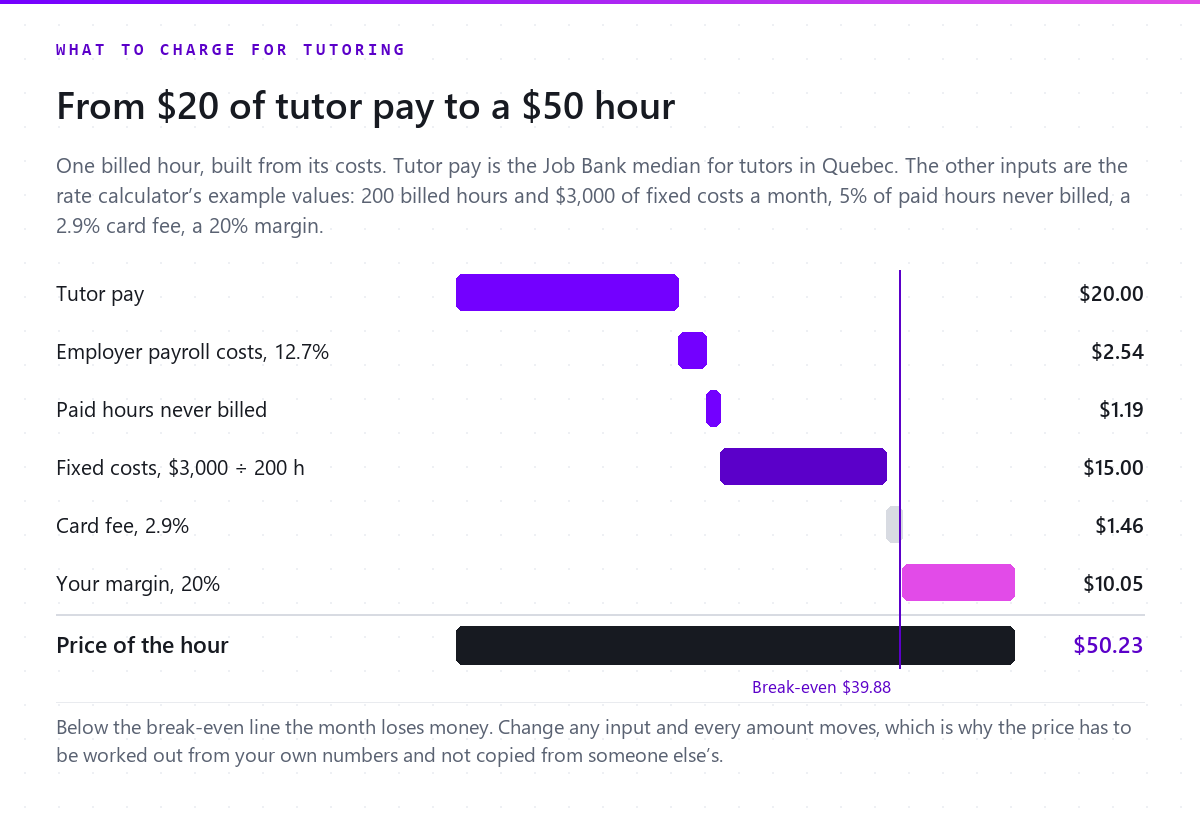
If 5% of the hours you pay never reach an invoice, each billed hour has to carry its own pay plus a slice of those unbilled ones. With a $20 tutor and 12.7% of payroll costs, that slice is $1.19 an hour. It looks small, and it grows with every no-show, which is why it belongs in the price and not in the hope that next month is better. The tutor pay and margin calculator shows what a pay run really leaves you once those hours are counted.
4. Your fixed costs, divided by the hours you bill
Rent, insurance, software, the admin who answers the phone. You owe them whether a lesson happens or not, so divide the month’s total by the hours you actually bill. In the example, $3,000 of fixed costs over 200 billed hours puts $15.00 on every hour, which is nearly as much as the tutor’s pay.
This is also where a quiet month hurts. The same $3,000 over 150 hours is $20.00 an hour. Your costs didn’t move and your price didn’t move, and the margin shrank anyway. If you want to see how many of your tutors’ hours actually get billed, the tutor utilization calculator works it out. And if software is one of your fixed costs, our pricing page shows the whole bill up front, by the number of active students.
5. The card fee
When a family pays by card, the processor keeps a percentage of the price, not of your cost, so it grows as the price grows. In Quebec you can’t pass it on to the family either, as the post on card fees and e-transfer explains. At 2.9%, it takes $1.46 out of a $50 hour.
Then the margin, and the price
Add the five and you have your break-even. In the example it is $39.88 an hour, and every hour sold below that loses money, however full the calendar looks.
The margin is your choice, and I’d say it plainly because nobody else will. A centre that keeps nothing has no cushion for the month a tutor leaves, the summer when families travel, or the day you want to hire. Ask for 20% in the example and the price comes to $50.23 an hour. Because the card fee and the margin are both shares of the price, the formula divides your costs by what is left after them, which is why $38.73 of cost becomes $50.23 of price and not the $46.48 you’d get by adding 20% to the cost.
The same hourly rate then gives you every session length. At $50.23, a 30-minute session is $25.11, 45 minutes is $37.67 and 90 minutes is $75.34. If you sell packs or a monthly plan, the tutoring rate converter does that step, and the post on pricing tutoring packages covers which structure to sell.
Run it with your own numbers
Every figure above except the tutor’s wage and the payroll rates is an example, and your centre’s will differ. The tutoring rate calculator does the same arithmetic with yours in about a minute, and gives you both prices, the one that covers your costs and the one that keeps your margin.
Once the price is set, the work is keeping it true. In Pillar OS each offering carries its price, a student can have their own, and each tutor can have their own rate per job, so the invoice and the pay run are both built from the sessions actually taught. What you charge and what you pay sit in the same place, and in my experience a margin you can see is a margin you can keep.

Steven Kallini · Founder
Mechanical engineer by trade, hooked on computers since he was a kid, and a principal process engineer for 13 years before Pillar OS. That job was finding where a process quietly leaked time and money, then designing the fix. Pillar OS is the same work, aimed at the admin that eats a tutoring owner’s week.
