

How tutors build trust with parents in 4 weeks
What research on families and schools says about trust, and a four-week plan for a tutor or centre: listen, keep your word, name one thing to work on, review.
Some of our centres
 Centre de Francisation et de Tutorat au Québec
 Coeur de Tuteur
 Lingua Franca Institute
 Mentors Éducation
 OnCourse Education
 Top Tutorat
 Tuteur Match
 Tutorat au Top

A family’s first month with a tutor is mostly quiet from their side. They paid, they drove their child over, they waited in the car or in the hall. What they know about the sessions is what their child says on the way home, which is often “fine.” Trust gets built or lost in that quiet, long before anyone looks at a report card.
Trust with parents is not a personality trait or a warm smile at the door. It is a short list of things a family can check for themselves, week after week, and the first month is when they check hardest.
What the research says parents judge you on
Most of the research on trust between families and educators comes from schools, but the mechanics carry over to a tutoring centre almost unchanged.
Researchers Adams and Christenson surveyed 1,234 parents and 209 teachers about trust in each other (the study’s annotation, SEDL). Parents of elementary students trusted teachers more than parents of high school students did, and parents with low or moderate trust took part less in their child’s schooling. When asked how to build more trust, families and teachers disagreed on most things but agreed on one: communication.
The Chicago schools research went further and named what people actually weigh. In her summary in Educational Leadership, Barbara Schneider writes that judgments of trust organize around four things: respect, personal regard, competence in the core job, and personal integrity. It also mattered for results. A school with weak trust had only a one-in-seven chance of improving academically, while half of the schools with strong trust were in the improved group.
For a tutor, those four translate plainly. Respect is listening before you decide. Integrity is doing what you said you would. Competence is seeing what the child needs and saying so. Personal regard is caring about the child past the end of the paid hour.
Short messages move more than you’d expect
Two field experiments by Matthew Kraft show how little it takes. In a summer program, a daily phone call home and a written message raised the odds a student completed their homework by 42%, and cut the times teachers had to redirect a student’s attention by 25% (Kraft and Dougherty).
In the second, teachers sent parents a weekly message of one sentence. The share of students who failed to earn course credit fell from 15.8% to 9.3%, a 41% reduction (Kraft and Rogers). The detail that matters most for tutors: messages about what the student could improve produced larger effects than messages about what the student was doing well.
Both studies took place in schools, with students who had to be there. A family who chose and paid for tutoring is not the same audience, so treat the size of the effects as a hint, not a promise. The direction is what counts: short, regular, specific messages change what happens at home.
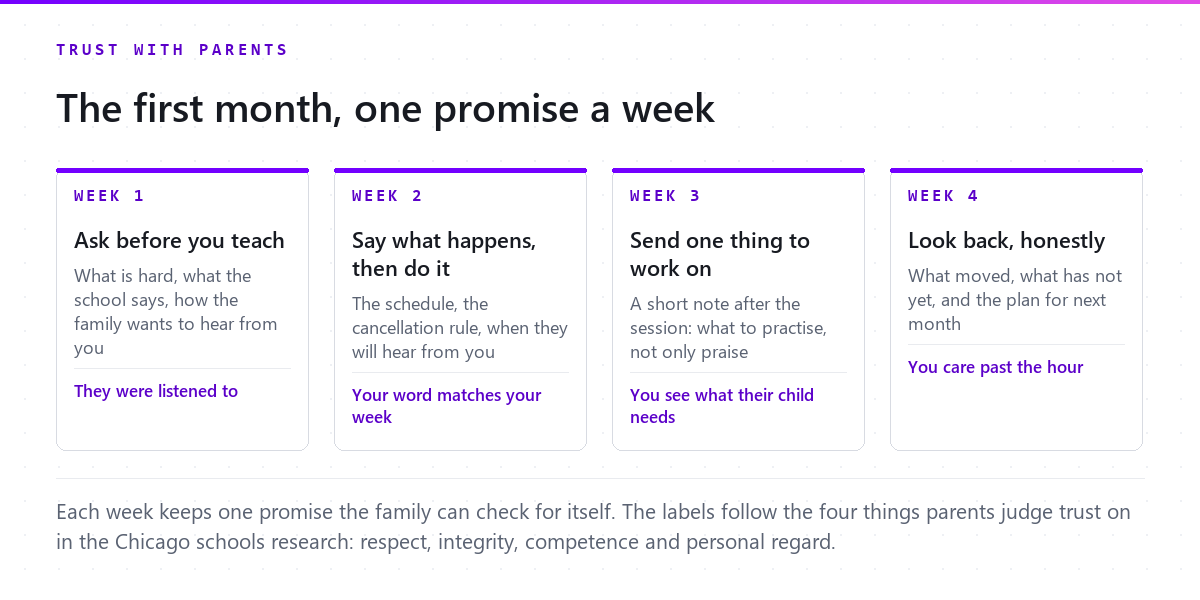
Week 1: ask before you teach
The first conversation is not a sales call and not a placement test. Ask three things and write the answers down where every tutor on the file can see them:
- What is hard right now? In the parent’s words, not yours. “She freezes on word problems” is more useful than “grade 7 math.”
- What does the school say? The last report card, a teacher’s comment, an upcoming exam.
- How do you want to hear from us? By email, by text, after every session or once a week. Some parents want every detail, some want to hear only if something is wrong, and both are fine.
The third question is the one most often skipped, and it is the one that shows respect. A family that chose a weekly summary and gets one every Friday learns that you listened.
Week 2: say what happens, then do it
Integrity in a tutoring centre is mostly logistics. Before the second session, the family should know the schedule, who the tutor is, how to cancel and by when, and when they will hear from you next.
Then keep every one of those promises. If the note was promised for Friday, it goes out Friday. If the tutor changes, the family hears it from you before they hear it from their child. Small promises kept are how a family learns that the big ones will be too.
Week 3: send one thing to work on
After the third or fourth session, the family should get a short note that names one specific thing. Not “great session today,” but “We worked on setting up word problems. Ask her to tell you what the question is asking before she starts calculating.”
This is where competence shows. It tells the parent you see something particular about their child, and it gives them one useful question to ask at home, which is what the improvement-focused messages in the Kraft and Rogers experiment did. Keep it to one thing. A list of six reads as a report card, and nobody acts on six.
Week 4: look back, honestly
At the end of the month, send a short review or have a ten-minute call. What moved. What hasn’t moved yet, said plainly. What the next month will focus on.
The honest part is what builds regard. A parent who hears “the fractions are solid now, the word problems will take longer, here is why” trusts the next good news more than one who only ever hears that everything is great. It is also the moment to check the answer from week 1: is this still how they want to hear from you?
When trust is already shaky
Some families arrive wary. A previous tutor who never said what they were doing, a child who has been “fine” for a year while the grades slid. The same four weeks apply, with two adjustments: make the first note sooner, after the very first session, and make it concrete. Wary parents don’t need reassurance. They need evidence, and a specific observation about their child is evidence.
The bottom line
Families decide whether to trust a tutor on four things they can check: were they listened to, did you do what you said, do you see their child clearly, and do you care past the hour. The first month is when they check, and short, regular, specific messages are how you show them.
So, Monday: for each new family this month, write down how they want to hear from you. Put the next promised note on your calendar. After the next session, send one sentence that names one thing to work on.
A portal does not build trust on its own, but it keeps the logistics promises for you. In the Pillar OS family portal, each child’s lessons can go straight into the parent’s own phone calendar, families book, move or cancel within your rules, and, where you allow it, they write to their tutor in Messages instead of through the office. When a tutor has to be away and you give the session to someone else, Pillar emails the family who will be teaching, so they hear it from you first. The questions parents send most often, and which ones a screen can answer, are on the parent questions page, and what a parent portal should answer for you goes through them one by one. For the homework side of the conversation, see homework between tutoring sessions.

Nelly Kallini · Co-founder
A high school teacher who has spent years tutoring, so she has been on the receiving end of nearly every feature here: the 8am reschedule, the progress report due tonight, the parent asking whether any of it is working. She writes the operations side of the blog.
