

Homework between tutoring sessions: what works
What the research says about homework, why the correction matters more than the task, and a four-step loop that starts at one session and closes at the next.

Every tutor knows the moment. The session is ending, there are a few minutes left, and you say it: “For next week, finish page 12.” The student nods. The parent in the doorway nods. A week later the page comes back half done, or doesn’t come back at all, and the start of the session goes to finding out why.
The page was never the problem. Homework between sessions works when it’s a loop, and most homework is only the first step of one.
What the research actually says
The best short summary is the Education Endowment Foundation’s Teaching and Learning Toolkit, which pools the studies and reports an average gain of about five months’ progress, larger in secondary school (+5 months) than in primary (+3). Three of its findings matter more to a tutoring centre than the headline number:
- Homework linked to the work done in class tends to be more effective, and studies that included feedback on the homework found higher impacts.
- Quality beats quantity. There is some evidence that the benefit shrinks as the time spent grows, and the review recommends making the purpose of each task clear to the student.
- The evidence is thinner than the headline. The EEF rates its security as low: 43 studies, many of them not randomized trials.
Harris Cooper’s synthesis of homework research points the same way. Every study it reviewed had design flaws, but across them the evidence for a positive effect was generally consistent, and the link between homework and achievement was stronger in grades 7 to 12 than in kindergarten to grade 6. In Québec, the Conseil supérieur de l’éducation went further for the younger end. Its opinion on homework in primary school noted that an effect on success in primary school had not been demonstrated, and that homework’s real value there was as a regular link between school and family.
So homework isn’t magic, and it isn’t useless. It works when it’s short, tied to what you just did together, and comes back with feedback. A tutoring centre is unusually well placed to do all three, because the person who gives the homework is the person who sees the student next.
The correction is the part that counts
Feedback is one of the strongest influences on learning, and one of the most uneven. John Hattie and Helen Timperley’s review, The Power of Feedback, found that its effect can be positive or negative, depending on the type of feedback and the way it is given. Their model asks three questions of any feedback: where am I going, how am I going, and where to next.
A check mark answers none of them. “Good job” answers half of one. A correction note that does its job is three short lines:
- One thing done well, named. “Your units were right in every answer” proves someone read the page.
- One thing to fix, with the step that fixes it. “In 4 the car is slowing down, so the acceleration is negative.”
- What happens next. “We’ll redo it together on Thursday.”
Three lines. They’re what turn homework into learning instead of paperwork. It’s also why the correction belongs before the session, not in it. Correcting in front of the student eats the session; correcting the night before lets the session open on the one thing that matters.
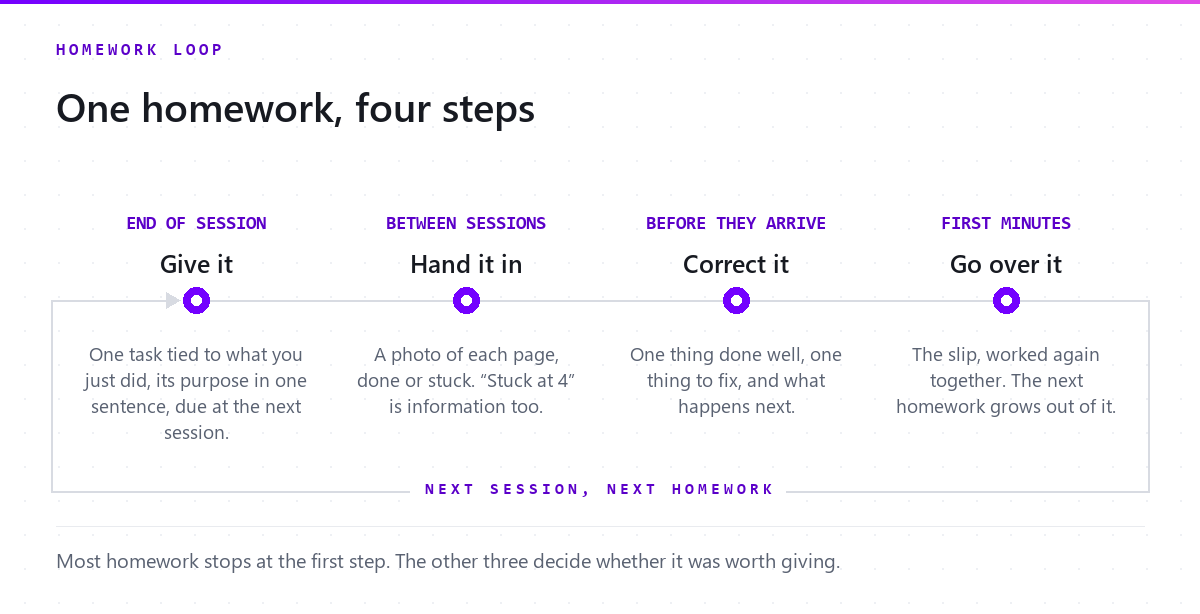
A loop you can run every week
1. Give it at the end of the session. One task, tied to what you just did, and one sentence on why: “Six problems like the ones we did, so the sign rule sticks.” Make the due date the next session itself, not “next time,” so the student, the family and the tutor all mean the same day.
2. Hand it in before the session. A photo of each page from a phone is enough. Ask for it a day ahead, and make “I got stuck at 4” an acceptable hand-in. A half-done page with an honest note tells you more than a perfect page copied from a friend.
3. Correct it before they arrive. The three lines above. If three students made the same slip, that’s your next warm-up, already written.
4. Go over it in the first minutes. Rework the slip together, then let the next homework grow out of it. That’s the loop: the correction decides the next task, and the student can see it happen.
The rhythm matters less than the closing. The highest-impact studies in the EEF review set homework twice a week in a subject, but a weekly loop that always closes beats a twice-weekly one that stays open.
Bring the family in, without making them the teacher
Families want to know what was asked and whether it was done. They don’t need to check the answers, and they shouldn’t be asked to. The Conseil supérieur de l’éducation is clear that parents, however much schooling they have, aren’t meant to stand in for a professional, and it recommends regular communication about homework between teachers, parents and the people who provide homework help. A tutoring centre is one of those people.
In practice that’s two messages. One when the homework is given: what it is and when it’s due. One when it’s corrected: what went well and what you’ll work on next. A parent who gets both can ask the only question that helps at home, “did you hand it in?”, without turning the kitchen table into a second lesson.
It also helps to remember that not every student has the same evening. The EEF and the Conseil both point out that some students have no quiet place to work, or nobody at home who can help. A few minutes at the centre before the session, or a task short enough for a bus ride, keeps homework from rewarding the students who already had the easiest week.
The bottom line
Homework earns its place when the loop closes: given with a purpose, handed in, corrected before the session, gone over at the start of it. Skip the last three steps and you’re handing out paper.
So, Monday: for each student this week, give one task tied to the session, with one sentence on why. Ask for a photo the day before. Write three lines on each one. Open the next session with the slip.
In Pillar OS that loop is built in. Homework is given from the session’s page, due at the next session by default, and the family is told right away. Students hand in photos or PDFs from the family portal, tutors correct on one Homework page where the students they see soonest come first, and the family gets an email with the tutor’s note once it’s corrected. The rest is on the homework page, and if you’d rather build the practice into lessons, here is how to build a course students actually use.

Nelly Kallini · Co-founder
A high school teacher who has spent years tutoring, so she has been on the receiving end of nearly every feature here: the 8am reschedule, the progress report due tonight, the parent asking whether any of it is working. She writes the operations side of the blog.