

Why families drift away from tutoring, and what to say
Almost nobody quits tutoring. They pause, and the pause lasts. When the drift starts, what a departure costs, and the four-week check-in that brings them back.

She was there every Wednesday at four for a year and a half. Then the March report card came home with the math mark up eleven points, and her mother stopped me at the door to say the nicest thing a customer can say. He’s doing so well. We’re going to take a little break.
That is how most families leave a tutoring centre. Nobody quits. Nobody is unhappy. Nobody asks for their money back. They pause, and the pause is still going in September, when the Wednesday slot has a hockey practice in it and a new tutor’s name on the board.

Four ways a family leaves, and only one is about the tutoring
After enough of these conversations I started keeping a list. It’s short.
| How it happens | What it sounds like | What was really going on |
|---|---|---|
| The good-news exit | “He’s caught up, we’ll take a break” | The mark went up. Nobody told them what comes after the mark |
| The pack ran out | “We’ll rebook when things calm down” | The last credit was used on a Tuesday and nobody noticed, including you |
| The schedule broke | “Wednesdays don’t work anymore” | Moving the session needed a phone call, and skipping it needed nothing |
| Nobody asked | Silence | They weren’t sure it was working, and nobody from the centre said what they saw |
Three of the four are logistics. The report card, the credit balance, the calendar. They are also the three you can see coming, if you’re looking.
In Quebec you can even put dates on it. Schools send report cards by 20 November, 15 March and 10 July, so the good-news exit has a season, and it’s the two weeks after each of those. If your quiet drop-offs cluster in late November and late March, that isn’t a coincidence. It’s the school calendar.
Why a pause costs more than a quit
A family who quits tells you. You get a reason, sometimes a fair one, and a chance to fix it. A family who pauses gives you nothing to work with, and by the time the gap is obvious it has stopped being a gap and started being their new week.
The student pays too. Most of the research on what happens when practice stops is about summer, and it’s honestly mixed on how big the loss is, but it agrees on the shape: progress doesn’t hold still, and math slips faster than reading. A student who was clicking in March and comes back in October is not picking up where they left off.
Steven does the numbers at Pillar, and his version of this is blunter. Take a centre with 60 active students that loses three in a typical month. That’s 5% of the roster a month, so the average student stays about 20 months. At four sessions a month at $55, one student is worth about $4,400 over their stay. Three leaving a month is 36 a year, and 36 times $4,400 is $158,400 walking out the door, most of it from families who were perfectly happy. Keep one more of those three each month, for a year, and $52,800 of it stays. Those are the calculator’s example numbers, not a benchmark, and yours are a minute away in the student retention calculator.
It’s the lesson every industry learns eventually. Amy Gallo’s much-quoted piece in Harvard Business Review puts the cost of winning a new customer at five to 25 times the cost of keeping one, depending on the study, and in a tutoring centre it’s easy to see why. A new family needs a trial, an assessment, a tutor match and three weeks of nerves before they trust you. The family you already have needs a message.
What a good check-in says
The four-week mark is the one that matters. Two weeks quiet is a holiday. Eight weeks quiet is a new routine, and nobody quits a routine by accident. Four weeks is the last moment a message still reads as care instead of sales, which is also why it’s the number Pillar uses to flag a student.
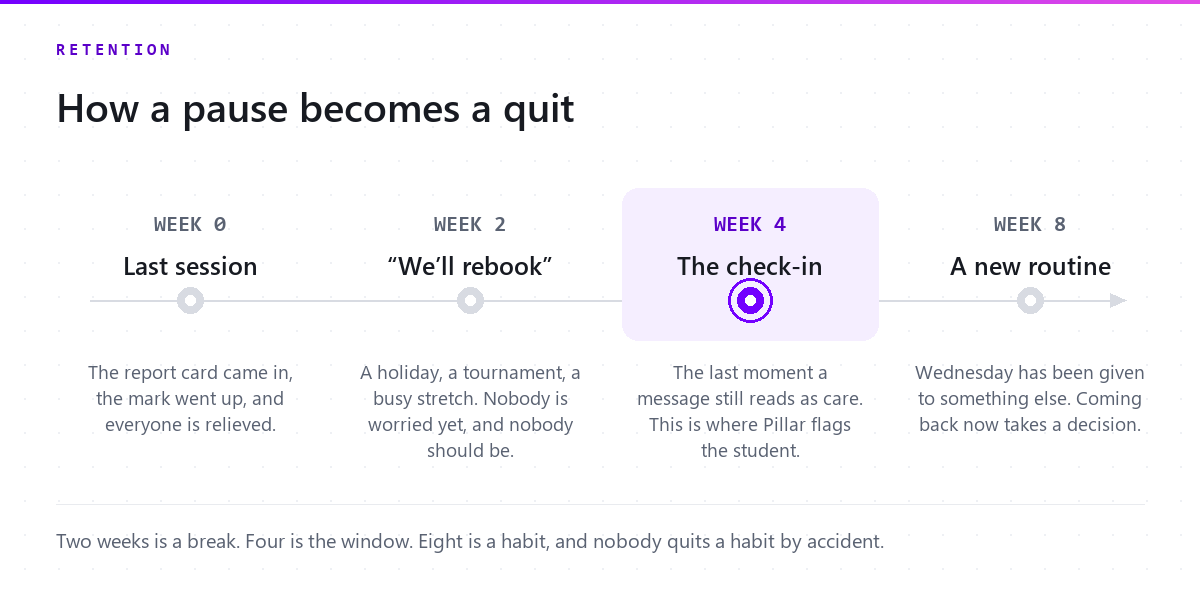
A good check-in has three parts and no discount.
- One specific thing about the student. “Léa’s fractions were clicking in March” beats “we miss you” every time, because it proves a person wrote it. If you can’t name one thing, that’s the problem to fix first, and it’s a conversation with the tutor, not a marketing one.
- One honest question. How is math going for her now? Not “are you ready to come back,” which has a yes or no answer, and no is the easier one.
- One easy next step. A link to the open slots, so a mother reading it at 10pm can act at 10pm. If the next step is “call us,” you’ve handed her a task, and tasks wait.
Put together, it’s about four lines:
Hi Sophie, it’s Nelly. Léa’s fractions were really clicking by the end of March, and Marc still talks about it. How is math going for her this term? If a session before the November report card would help, here are Marc’s open times this month. And if not, just say so. We’re glad it stuck.
The reason there’s no discount is that a discount teaches families that leaving is how you get one. It also changes what the message is. Fifteen percent off is marketing. A note about Léa’s fractions is a teacher who noticed.
Get ahead of the three moments you can see coming
Since three of the four exits sit on a calendar, most of this can be said before the pause instead of after it.
- Before the report card lands, tell the family what the next term is for. The good-news exit happens because the goal was “get the mark up” and the mark went up. If the goal is “hold it through the exam period, then start the next unit early,” the family has a reason to keep the Wednesday. Say what you see and what comes next, in writing, in the week before those dates.
- Before the last credit, not after. A family with one session left on a pack should hear from you before the balance is zero. “You have one left, here’s what we’d suggest next” is a renewal conversation. “You ran out three weeks ago” is a re-engagement one, and those are harder.
- Before summer, ask directly. Some families will stop for July and August whatever you do, and that’s fine. The ones who book September in June are the ones you asked in June.
Make coming back easier than staying away
A parent who decides at 9pm on a Sunday that it’s time to go back should be able to book by 9:05. If it takes an email exchange, or a phone call in office hours, a real share of those decisions evaporate by Monday. That’s the whole case for a family portal where they see the open times and take one, and it’s the same fix that stops no-shows, because it’s the same problem. The distance between a good intention and a booked session.
Worth knowing, too, that in Quebec a family can cancel a course contract at any time, and the law caps what you keep when they do. Retention here was never a contract. It’s a relationship, and relationships are kept with attention, not clauses.
The bottom line
Retention feels like something that happens to you. It’s mostly something that happens on a calendar you can read.
So, Monday: pull the list of every active student who hasn’t had a session in four weeks. Send five check-ins, each with one specific thing and one easy next step. Write down which packs run out this month and message those families first. And before the next report card, tell each family what the term after it is for.
In Pillar OS the four-week list builds itself, oldest lapse first, next to the credits each family has left, and a check-in is drafted for you to read and change before anything goes out. The parent portal is where a family books their way back at 9pm, and scheduling is what keeps the Wednesday theirs. If the pack itself is part of the problem, how you price tutoring decides how often you have this conversation at all.

Nelly Kallini · Co-founder
A high school teacher who has spent years tutoring, so she has been on the receiving end of nearly every feature here: the 8am reschedule, the progress report due tonight, the parent asking whether any of it is working. She writes the operations side of the blog.