

You cannot calculate last quarter's tutor utilization rate
Utilization is booked hours over available hours, and availability is a setting rather than a history, so every backward looking number is an estimate.
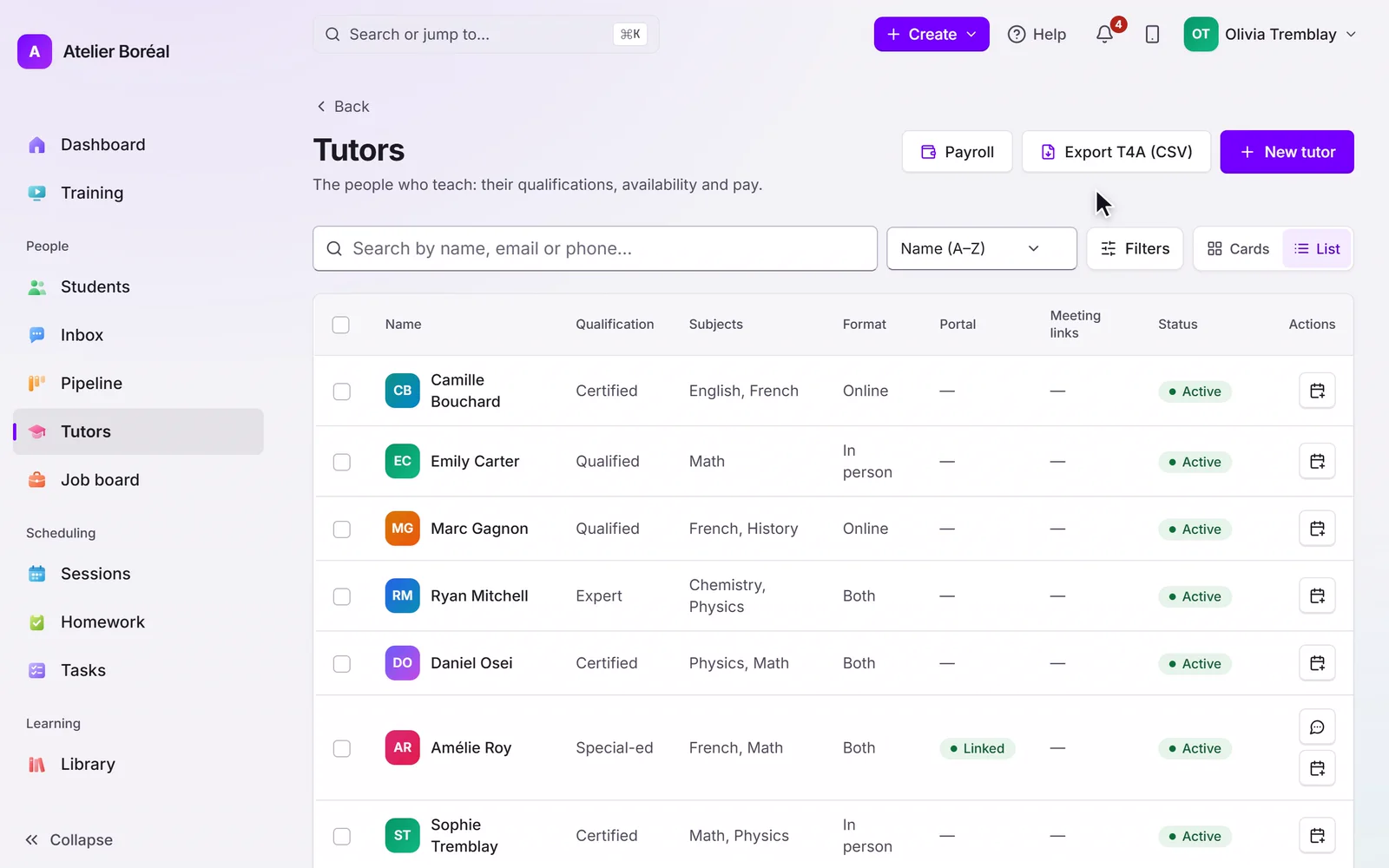
Some of our centres
 Centre de Francisation et de Tutorat au Québec
 Coeur de Tuteur
 Lingua Franca Institute
 Mentors Éducation
 OnCourse Education
 Top Tutorat
 Tuteur Match
 Tutorat au Top

Capacity does not keep a memory.
You can sit down this afternoon and work out how busy your tutors are this week, and the number will be honest and useful and worth acting on. Then you can ask the same question about last June and get an answer that is confidently wrong. Nothing broke along the way. That number was simply never written down.
Utilization is booked hours divided by available hours. Your booked hours are a record and your available hours are a setting, and only one of those survives contact with time.
The formula was never the hard part
Every guide hands you the same arithmetic and the same target band. Commonly quoted ranges sit around 70 to 85% for employed tutors and lower for contractors, who keep their own calendars, and scaling advice for tutoring businesses leans on the same figure.
None of that is wrong and you have probably run it yourself. It just assumes both halves of your fraction are facts you can look up, and only the top half of yours is.
Your booked hours are a record. Every session that happened left a row behind with a date on it, and you can count last June now or count it in five years and get the same answer both times.
Your available hours are not a record. They are a template, a weekly pattern plus approved time off plus a handful of exceptions, and that template answers who is available right now. It was never built to answer who was available last June and it cannot learn to.
Measuring a room with a tape that shrinks
Picture yourself measuring a room in April and writing the number on your wall, and then measuring that same room in August with a tape that has quietly lost a third of its length. Same room, same wall, different answer. Nothing about your second measurement announces itself as wrong.
That is what happens to utilization every time your team changes.
A tutor cuts back from twenty hours a week to ten and the tape gets shorter. Run last spring again today and the denominator uses the ten, and an ordinary spring reads back as an excellent one.
A tutor leaves and they come out of the template entirely, and their idle hours come out of every past calculation with them. We end up with a history that improves a little every time somebody quits.
Summer arrives and availability contracts in July and stretches again in September, and we hold the two side by side and tell ourselves we got busier.
Notice what all three have in common. Every one of them makes the number look better, and every one does it in exactly the conditions where we would want it to look worse.
The problem already has a name
None of this means your software is broken. It is doing the job it was built to do, which is keeping records, and a record tells you what happened rather than what was possible. Utilization is entirely a question about what was possible.
Data people named our problem a long time ago. An attribute that changes over time can either be overwritten with the new value or versioned so the old one survives with dates attached, and Kimball’s slowly changing dimensions call the first one Type 1 and the second one Type 2. Availability in almost every scheduling system is Type 1. The new value lands on top of the old one and the old one is gone.

There is no export for this and no backup and no clever query that brings it back to you. Your tape was never marked.
What we should do instead
Two things, and the second one matters far more than the first.
Use today’s number for today’s decisions. Utilization measured against this week’s real availability is honest and genuinely useful, and it will tell you whether to hire and whether to push a promotion and whether a particular tutor has room for two more students. Just do not line it up beside last month’s figure and call the pair a trend, because those were two different measurements wearing the same label.
Then start writing it down every night. Once a day, record two numbers, the minutes you booked and the minutes you had available according to the template as it stood that day. Two integers and a date.
If there is one thing thirteen years of process engineering taught me, it is that you cannot improve what nobody was measuring at the time. A reading taken on the day is a fact forever. The same reading reconstructed afterwards is a guess wearing a lab coat. And because capacity cannot be backfilled, the earliest day you will ever be able to report on is the day you start.
That is the uncomfortable part. Every week we spend deciding whether this is worth the bother is a week we will never be able to look at again.
The trend was always the point
A single utilization figure is close to useless to you on its own. Your 74% means one thing if your last month was 68% and something completely different if it was 81%, and without its neighbours your number is just a shape.
That is what we lose by not recording it. Not today’s figure, which we can always work out, but the trend, and a year from now we will still be making the same hiring call off the same lonely snapshot and wondering why it never gets any easier.
This is why Pillar OS writes both numbers into a daily table every night, the minutes booked and the minutes available, measured against that day’s real availability, so the series starts when a centre starts rather than when somebody finally asks for a report. The table is part of Pillar’s software for tutoring centres, fed by the same calendar families book on.
The habit matters more than the tool though. A spreadsheet with a date column and two integers, filled in every Friday afternoon, beats a sophisticated dashboard computing the number backwards.
Start today, because today is the earliest you can
Stop asking how busy we were last quarter. That answer is gone and no software is going to find it. Ask how busy we are this week, write it down somewhere it cannot be overwritten, and ask again next Friday.
In three months you will have something no target range can hand you, which is your own baseline, measured rather than estimated.
If you want the rest of the numbers worth keeping as a centre grows, we put them in our tutoring growth playbook and it downloads straight away.
Mark what is in front of you and the system improves. That has been true of every process I have ever been asked to fix, and it is true of this one.

Steven Kallini · Founder
Mechanical engineer by trade, hooked on computers since he was a kid, and a principal process engineer for 13 years before Pillar OS. That job was finding where a process quietly leaked time and money, then designing the fix. Pillar OS is the same work, aimed at the admin that eats a tutoring owner’s week.
