

How much to pay tutors, and what a session leaves you
The tutor rate is the biggest line in a tutoring business and the least examined. What one session leaves after pay, payroll costs, card fees and empty chairs.

The biggest number in your business was set in a hurry. You hired your first tutor on a Tuesday afternoon and she asked what it paid and you said thirty dollars an hour because it sounded fair and it was what you’d heard, and three years later thirty dollars an hour is still the rate and every session in the building runs through that one decision.
The price went the other way. You set it once, you raised it twice when the rent went up, and you never once put the price and the rate on the same page to look at what was left between them. If there’s one thing thirteen years of process engineering taught me, it’s that the number nobody owns is the number that drifts.

What one session actually leaves
Take a session that sells for $55 and pays the tutor $25. Most owners stop there and call it a $30 margin, and that’s the arithmetic that keeps a business poor. Three more hands reach into the $55 before it’s yours.
| Line | Amount | Where it comes from |
|---|---|---|
| Tutor pay | $25.00 | The rate you set on a Tuesday |
| Payroll costs on top of pay (12%) | $3.00 | Employer contributions on the pay |
| Card processing (2.9%) | $1.60 | The processor’s cut of the price |
| No-shows paid for, not billed (1 in 20) | $1.47 | The empty chair, spread over the sessions that pay |
| Left per billed session | $23.93 | Yours, before rent |
So a session that looked like $30 leaves $23.93. Now multiply. At 240 billed sessions a month that’s about $5,744, and if the fixed costs are $4,500 the month ends at about $1,244. The break-even is 189 sessions. Below that, every month is a loan to the business, and above it every session is nearly twenty-four dollars of actual money.
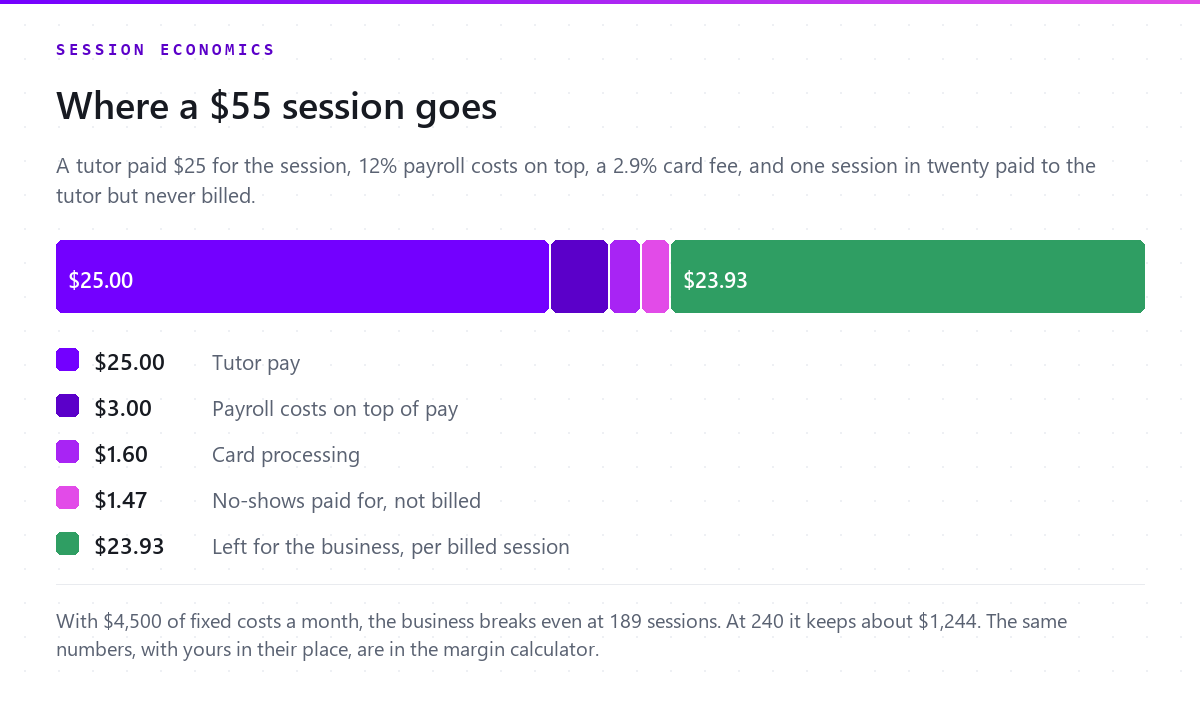
Those are the example numbers in the tutor pay and margin calculator, and the whole point of the calculator is to replace them with yours, because the shape is the same in every centre and the numbers never are.
The three costs that hide behind the rate
Payroll costs. If your tutors are employees, the rate is not what they cost. Revenu Québec lists what an employer pays on top of wages, employer contributions to the QPP, parental insurance premiums, the health services fund, the labour standards contribution and the Workforce Skills Development and Recognition Fund, and the CNESST premium is paid alongside them. The percentage depends on your payroll and the year, so ask your accountant for yours and type it in. Twelve percent is the example, not a promise.
The contractor question. Many centres pay tutors as contractors and enter zero for that line, and some of them are right. The CRA’s guide on employee or self-employed status looks at who controls the work, who provides the tools, whether the worker can subcontract, and who carries the financial risk, and in Quebec the question turns on whether there is a relationship of subordination under the Civil Code. Get it wrong and the guide is plain about what follows. An employer who failed to deduct pays both the employer’s share and the employee’s share, plus penalties and interest. I’m not your accountant and this isn’t advice. My opinion is that a tutor who works your schedule, in your room, with your materials, at your rate, is a harder contractor case than most owners assume, and that the careful version of the calculator has a number in that box.
The card. Stripe’s published rate in Canada is 2.9% plus 30 cents per transaction, with more on top for international cards or a currency conversion. On a $55 session that’s about $1.90, and the 30 cents is per transaction, not per session, which is one quiet argument for selling packs. A family paying for ten sessions at once pays the 30 cents once. E-transfer costs you the time to match it to an invoice, which isn’t free either, but it’s a different line.
The empty chair. A no-show you don’t charge for still pays the tutor. If one session in twenty goes that way, every nineteen that bill are carrying the twentieth, and that’s $1.47 on each of them in the example above. It looks small, and it’s the only line on the table that is entirely a policy choice. The no-shows post is about making it smaller.
Price and volume are not the same lever
Owners who feel the squeeze reach for volume. More students, more sessions, a second room. Run the numbers first, because the two levers are not the same size.
In the example, raising the price from $55 to $60 moves the month from about $1,244 to about $2,409, because nearly all of the extra five dollars is yours. The card takes fifteen cents of it and the tutor takes none. To get the same $1,165 from volume you’d need about 49 more billed sessions a month at the old price, which is a dozen new students at four sessions each, found, assessed, matched and kept. One of those is a decision. The other is a season of recruiting.
The rate cuts the other way just as hard. Move the tutor from $25 to $30 across the board, with the same 12% on top, and the same month goes from $1,244 up to $171 down, and the break-even climbs from 189 sessions to 250. I’m not saying don’t raise pay. I’m saying a raise is a pricing decision, and it deserves the same page.
So what do you pay a tutor
Start from the price, not from the going rate. Decide what the business has to keep per session to cover the fixed costs at the volume you actually run, plus what you want to make, and what’s left is the ceiling for pay and everything on top of it. Then pay well inside that ceiling, because a good tutor who stays is worth more than the two dollars a session you’d save on a worse one, and turnover has a price this table doesn’t show.
Pay from the session, not from the clock. A rate that changes with the kind of work, a senior tutor on exam prep at one number and a first-year on homework help at another, is a business that knows what each session leaves. A flat rate for everyone is a business that hopes.
And write the pay down where both of you can read it. I believe a tutor should be able to see exactly how their pay was built, the sessions, the hours, the rate, on one line, and I believe the owner should be able to read the same line before the money goes out. Most payroll arguments in a tutoring centre are two people holding two different lists.
The bottom line
Put the price and the rate on the same page this week, with the three costs between them. Then ask what one session leaves, and whether the sessions you run cover the rent at that margin. If they don’t, you have a pricing problem wearing a growth problem’s coat, and no amount of volume fixes it.
In Pillar OS this lives in tutor management, where each tutor’s pay is built from the sessions they actually taught, hours and rate on one line you read before the pay run, and a rate can sit on the tutor or on the program so the same person is paid differently for different work. Billing is where the price sits. The number that matters is the one between them, and a number nobody owns is a number that drifts. Own this one.

Steven Kallini · Founder
Mechanical engineer by trade, hooked on computers since he was a kid, and a principal process engineer for 13 years before Pillar OS. That job was finding where a process quietly leaked time and money, then designing the fix. Pillar OS is the same work, aimed at the admin that eats a tutoring owner’s week.